
Leasing has always appealed to drivers who want a newer vehicle, predictable payments, and flexibility. But 2026 is shaping up to be an especially smart year to shop for car lease deals as inventory improves, manufacturers compete harder for attention, and shoppers become more value-focused than ever.
That said, getting the best car lease deals in 2026 has less to do with luck and more to do with process. The difference between a regular lease and an excellent one can be hundreds (or thousands) of dollars over the term based on factors most people overlook, such as residual value, money factor, mileage structure, and lease-end fees.
Finding the Best Car Lease Deals in 2026
The good news is that you don’t need to be a leasing expert to secure a great deal. You simply need to know what to compare, when to shop, and how to identify a genuinely competitive lease, not just advertised to look that way.
In this guide, we will walk you through:
- How car leasing works in plain terms.
- What makes a lease good in 2026 (beyond the monthly price)?
- The best deal types to look for, including electric vehicle (EV) lease deals in 2026, sports utility vehicles (SUVs), luxury models, and short-term options.
- How to compare car lease offers efficiently using a marketplace approach.
- The lease checklist and common mistakes to avoid.
If your goal is to find the lowest monthly car lease without sacrificing value, you’re in the right place.
How Car Leasing Works: A Simple Breakdown
Before you can compare deals confidently, it helps to understand what you’re paying for.
What a Car Lease Actually Is
A lease is essentially a long-term rental agreement. You pay to drive a vehicle for a set period (often 24-36 months) and return it at the end, typically with the option to buy it for a pre-set price.
Unlike financing, you are not paying to own the car. You are paying for:
- Depreciation: How much value the car loses during your lease term.
- Financing Charges: Often expressed as a money factor instead of an annual percentage rate (APR).
- Taxes and Fees: Which vary by state and lender.
Key Components of a Lease Agreement
Most lease payments are shaped by a few core variables:
- Manufacturer’s Suggested Retail Price (MSRP): Used to calculate the residual value
- Negotiated Vehicle Price: The selling price you should negotiate (yes, even on a lease)
- Residual Value: What the vehicle is projected to be worth at lease-end
- Money Factor: The lease’s finance charge (convertible into an APR equivalent)
- Term Length: Commonly 24, 36, or 39 months
- Mileage Allowance: Often 10,000-12,000 miles/year, sometimes 15,000
Monthly Payment vs. Total Lease Cost
A low payment doesn’t always mean a good deal. Two leases can have the same monthly number but very different total costs because of:
- High upfront fees (due at signing)
- Short-term loans that inflate payments
- Add-ons and protection packages
- Expensive lease-end charges
In 2026, shoppers who win are the ones who look at the full lease structure, not just the payment.
Why Comparing Multiple Offers Matters
Leases are not standardized. Two dealerships (or brokers) can offer the same vehicle with different:
- Money factors
- Incentives
- Fees
- Terms and mileage programs
That is why the smartest strategy is to compare car lease offers before committing.
Why a Leasing Marketplace Beats Visiting One Dealer

Many drivers still approach leasing the traditional way: pick one dealership, pick one car, accept what is offered. That approach can work, but it often leaves money on the table.
Access to a Broader Inventory and Pricing
When you shop at one location, you are limited to what that dealer has and how that store structures lease pricing. A marketplace approach expands your options so you can spot value faster.
Transparent Comparison of Offers
One major advantage of a car leasing marketplace is the ability to compare multiple listings and terms without starting from scratch each time.
For example, at Any Auto Leasing, we display inventory with filters by body style, make, model, lease term, miles per year, and year, making it easier to narrow deals based on your budget and driving needs.
Time-Saving Benefits
Instead of calling five dealerships and repeating the same conversation, a marketplace method lets you quickly identify which offers are worth pursuing and which ones are not.
Better Negotiation Leverage
When you can show you are comparing multiple options, negotiations become more straightforward. Dealers and brokers tend to be more competitive when they know you have choices.
A Centralized Solution Platform
Any Auto Leasing is a leasing lead platform that helps drivers discover competitive lease specials and inquire about vehicles efficiently.
We also connect drivers with auto brokers who can source vehicles across multiple networks, helping reduce the back-and-forth typically involved in leasing.
What Makes a Car Lease Deal Good in 2026
A good deal isn’t only about a low payment. It’s about value. Here’s what matters most.
- Competitive Monthly Payment
Yes, payment matters, but only in context. The best lease payments are backed by strong fundamentals:
- High residual value
- Low money factor
- Meaningful incentives
- Minimal unnecessary fees
- Strong Residual Value
Residual value is the projected value of the car at the end of the lease. Higher residuals often mean lower monthly depreciation costs and better payments. This is why some models lease exceptionally well even if their purchase price is higher.
- Low Money Factor
The money factor is essentially the financing rate of the lease. You can convert it into an APR equivalent by multiplying by 2,400. A lower money factor means a lower finance charge.
- Reasonable Mileage Allowance
Your mileage is one of the fastest ways a great deal becomes expensive. Pick mileage based on reality, not optimism. If you drive 13,000 miles per year, a 10,000-mile lease can create painful overage fees later.
- Minimal Upfront Costs
A true value lease typically avoids heavy due at signing requirements. Be cautious with offers that advertise the lowest monthly car lease payment but require a large down payment to get there.
- Clear and Fair Lease-End Terms
Look for transparency on:
- Wear and tear rules
- Disposition fees
- Purchase option pricing
- Mileage overage charges
A good lease is one you can exit without surprises.
Best Types of Car Lease Deals to Look for in 2026
Not every best lease deal looks the same. Your ideal deal depends on what you drive, how you drive, and what you prioritize.
Best Low Monthly Payment Leases
If your goal is a cheap car lease in 2026, target:
- High-volume sedans and compact crossovers
- Models with strong residuals and factory support
- Standard trims (premium trims can inflate payments)
Pro Tip: The lowest payments often come from vehicles that manufacturers are aggressively pushing through incentives.
Best EV and Hybrid Lease Deals
EV lease deals in 2026 can still be excellent, but the landscape is changing. For several years, EV leases were unusually low in many cases because manufacturers could apply federal incentives more easily through leasing structures.
Some of those federal advantages changed after September 30, 2025, which means 2026 EV lease pricing depends more heavily on automaker incentives and regional programs.
Still, EV leasing remains attractive because it can reduce your exposure to long-term battery depreciation while letting you upgrade faster as technology improves.
Best SUV and Family Vehicle Leases
SUV lease deals tend to be strongest in:
- Compact and midsize SUVs
- Family-friendly three-row models during incentive periods
- Vehicles with a strong resale reputation
For families, leasing can make sense because it delivers predictability (payment and warranty coverage) during high-expense years.
Best Luxury Lease Deals
Luxury vehicles can lease extremely well when incentives align. A luxury lease becomes compelling when:
- The residual value is strong
- The money factor is competitive
- Dealer discount is meaningful (yes, you negotiate this)
Luxury leasing is often about timing and comparing more than one offer.
Best Short-Term Lease Options
If you need flexibility, look for:
- 24-month terms
- Subscriptions or short-term lease programs (where available)
- Lease takeovers (in some marketplaces)
A short-term car lease can be a great fit if you expect life changes in the next two years (relocation, business transition, or upgrading to an EV later).
How to Search and Compare Lease Deals on Any Auto Leasing
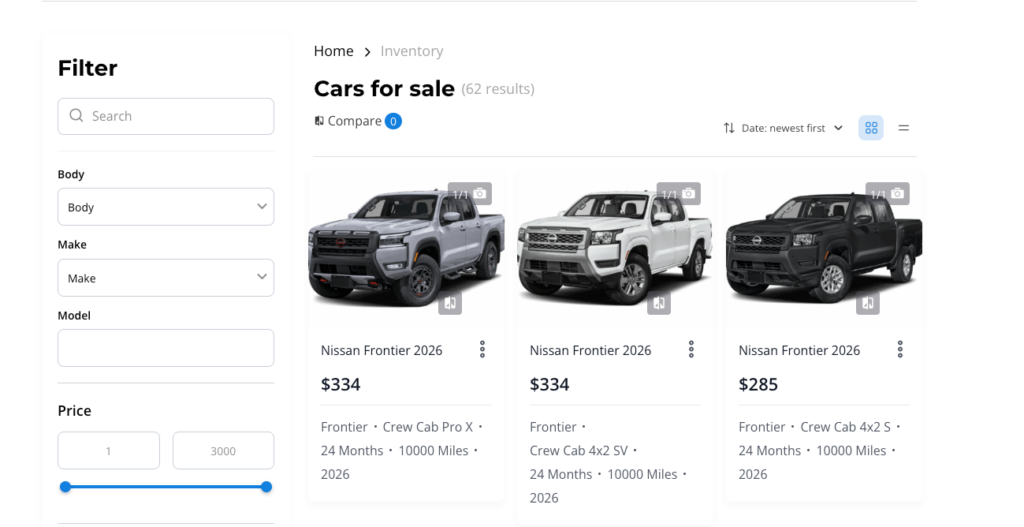
Shopping smarter starts with filtering properly. At Any Auto Leasing, we showcase lease listings and allow drivers to narrow results by vehicle type and term details, helping shoppers identify competitive options faster.
- Use Filters That Match Your Real Needs
Start with:
- Body style (SUV, sedan, pickup, etc.)
- Make/model preferences
- Term length (24 vs. 36 months)
- Mileage allowance (10K, 12K, 15K)
- Model year
The more accurate your filter set is, the more accurate your comparisons become.
- Sort By Value, Not Just Price
Low monthly payments can be misleading if fees are high. When you compare car lease offers, look at:
- Term length
- Miles per year
- Whether the payment assumes a down payment
- Any listed package or trim details
- Read the Offer Details Carefully
A lease listing often includes:
- Vehicle and trim
- Term and mileage structure
- Monthly payment (sometimes excluding taxes/fees)
Always confirm what is included so you are comparing apples to apples.
- Identify Hidden Costs and Fees
Common lease fees include:
- Acquisition fee
- Documentation fee
- Registration/taxes
- Disposition fee (lease-end)
A deal can look fantastic until fees are added.
When Is the Best Time to Find Car Lease Deals?
If you want the best price, timing matters.
End of the Month and End of the Quarter
Dealers and brokers often push hardest at:
- Month-end
- Quarter-end
- Year-end
This is when lease programs and inventory decisions tend to get more aggressive.
New Model Year Releases
When a new model year launches, prior-year inventory can come with stronger incentives, especially if the refresh is significant.
Seasonal Promotions
Holiday events and manufacturer promotions can offer:
- Lease cash
- Special APR or money factors
- Reduced due-at-signing requirements
Manufacturer Incentive Periods
Incentives can change monthly. Comparing across time windows can lead to better terms, especially on EVs and SUVs.
Special Focus: EV and Hybrid Lease Deals in 2026
EV leasing has been one of the biggest value opportunities in recent years, and it remains important in 2026, just with different rules.
Why EVs Lease Well
EVs can be strong lease candidates because:
- Technology changes quickly
- Battery depreciation can be unpredictable
- Leasing reduces long-term resale risk
Incentives and Credits
As we mentioned, leasing has historically allowed incentives to be applied more flexibly than purchasing in many cases. However, recent policy changes reduced certain federal advantages after September 30, 2025.
That doesn’t mean EV leases are no longer competitive. It means you need to compare more carefully, focusing on:
- Manufacturer lease incentives
- Dealer discounts
- State or regional programs (where applicable)
Battery Depreciation Advantage
If you love EVs but worry about long-term battery value, leasing gives you a clean exit strategy. This matters in 2026 as more EVs come off lease and the used EV market evolves.
How to Lower Your Monthly Lease Payment
If you want the lowest monthly car lease, focus on strategies that reduce the payment the right way.
- Negotiate the Vehicle Price First
Your lease payment is heavily influenced by the negotiated selling price (cap cost). Treat it like a purchase negotiation before discussing payment.
- Choose the Right Mileage Allowance
Higher mileage increases the lease cost. But choosing too low is worse. Pick a mileage plan that fits your real driving pattern to avoid overage charges later.
- Avoid Unnecessary Add-Ons
Some add-ons increase payment without increasing value, such as:
- Expensive paint protection
- Dealer-installed accessories you did not ask for
- Overpriced maintenance packages
- Leverage Incentives and Rebates
In 2026, incentives can make or break a deal. Always ask what programs are available, including:
- Loyalty incentives
- Conquest offers (switching brands)
- Manufacturer lease incentives
Common Lease Mistakes That Reduce Deal Quality
Most lease disappointments come from a few predictable mistakes.
- Focusing Only on the Monthly Price: A low payment can hide:
- Large due-at-signing amounts
- Short terms with inflated monthly numbers
- Hidden fees
- Ignoring Total Lease Cost: Calculate what you will pay over the full term, not just per month.
- Underestimating Mileage: Mileage overages can be expensive and easily avoided with a realistic plan.
- Signing Without Comparing Offers: Comparing at least three lease structures is one of the simplest ways to improve your odds of getting a better deal.
Lease vs. Buy in 2026: Which Is Better for You?
The lease or buy decision in 2026 depends on how you use your vehicle and what you value most.
Leasing Often Makes Sense if You Want:
- Lower monthly cost than financing (in many cases)
- Warranty coverage during your ownership period
- A new vehicle every 2-3 years
- Reduced long-term maintenance surprises
Buying May Be Better if You Want:
- Long-term ownership with no mileage limits
- Equity in your vehicle
- The ability to keep the car for many years after payoff
Business vs. Personal Leasing
Business car leasing can be attractive when it supports predictable budgeting and vehicle rotation. However, tax treatment depends on your structure and usage, so professional guidance is recommended.
Using Lease Calculators and Financial Tools
A car lease calculator helps you compare scenarios objectively.
Estimating Monthly Payments
A lease payment generally includes:
- Depreciation portion
- Finance charge
- Taxes and fees
The money factor plays a big role in the finance charge.
Calculating Total Lease Cost
Always estimate:
- Total monthly payments over the term
- Due at signing
- Lease-end fees
This prevents you from overvaluing a low monthly payment that requires high upfront cash.
Evaluating Scenarios
Try comparing:
- 24 vs. 36 months
- 10K vs. 12K miles/year
- $0 down vs cash down
A good calculator makes it obvious when a deal is only cheap on the surface.
Best Lease Deals by Driver Type
Different drivers should prioritize different deal structures.
- Daily Commuters: Look for:
- Strong fuel economy or EV value
- 12K-15K mileage options
- Models known for high residual value
- Families: Prioritize:
- SUV lease deals with safety packages
- Comfort, space, and predictable operating costs
- Reasonable mileage flexibility
- Business Owner: Consider:
- Vehicle category that matches your work needs
- Flexible terms for changing demands
- Stable payment structures for budgeting
- Short-Term Residents and Expats: A short-term car lease or 24-month term can be ideal when long-term ownership is not practical.
Lease-End Terms You Must Understand
Lease-end costs are where many drivers get surprised.
- Wear and Tear Rules: Understand what counts as chargeable wear, including:
- Tire condition
- Windshield chips
- Interior damage
- Excessive scratches or dents
- Mileage Overage Fees: If your contract is 10,000 miles/year and you drive more, you will pay per mile at the end.
- Disposition Fees: Many leases charge a fee when you return the car. It may be waived if you lease again through the same lender, but do not assume.
- Purchase Option Clauses: Most leases include a buyout price at the end, often tied to residual value.
If you think you might buy the car later, make sure you understand how that price is set.
Checklist Before Signing Any Lease Agreement
Before you finalize anything, use this checklist to protect yourself:
- Confirm the total cost, not just the payment
- Review all fees, including acquisition and disposition
- Verify mileage limits match your real driving
- Understand lease-end conditions for wear and tear
- Confirm insurance requirements
- Compare at least three offers to validate value
This one step alone can dramatically improve lease quality.
Frequently Asked Questions (FAQ)
- What credit score is needed for the best car lease deals?
In general, the strongest lease programs are offered to well-qualified buyers. However, approval and pricing depend on more than score alone: income, credit history depth, and debt-to-income ratio all matter. If your credit is not perfect, comparing multiple offers becomes even more important.
- Are EV lease deals cheaper than gas vehicles?
Sometimes. EV leases were often unusually inexpensive in recent years due to incentive structures, but some federal advantages changed after September 30, 2025. In 2026, EV value depends more heavily on automaker discounts and regional incentives.
- Is zero-down leasing a good idea?
A zero-down car lease can be a smart option because it reduces the cash you risk upfront. The payment is usually higher, but you keep your money liquid, and if the car is totaled early in the lease, you are less exposed.
- Can I end a lease early?
Yes, but it can be expensive. Early termination often includes payoff costs, remaining payments, and fees. If you think you may need flexibility, consider shorter terms or explore takeover options where available.
- Can I lease a used vehicle?
In some cases, yes, through certified pre-owned leasing programs. Availability varies, and pricing can be less predictable than new leases, but it can work well for specific vehicle types and budgets.
How to Secure the Best Car Lease Deal in 2026
Finding the best car lease deals in 2026 isn’t about chasing the lowest advertised payment but comparing the right data points: money factor, residual value, mileage structure, upfront cost, and lease-end terms, so you can confidently choose a lease that delivers real value.
To get better lease results in 2026, set your budget, mileage, and term, then compare multiple offers, not just one dealer. Negotiate the price first, use a lease calculator to confirm the numbers, and review lease-end fees before signing.
At Any Auto Leasing, we simplify this process by showcasing competitive lease listings with filters (term, mileage, make/model) and helping drivers inquire more efficiently, so you spend less time searching and more time driving the right vehicle at the right price.
If you are ready to start shopping, focus on the offers that fit your real-world driving needs and compare enough deals to know you are getting the best value available.